 Skip to content
OMAD vs Alternate Day Fasting: Which Is Right for You?
What You’ll Learn
In this article, we’ll delve into two popular intermittent fasting methods—One Meal a Day (OMAD) and Alternate Day Fasting (ADF). We’ll compare their fasting schedules, caloric intake, health benefits, sustainability, and the scientific evidence supporting each approach. By the end, you’ll have a clear understanding of which method aligns best with your health goals and lifestyle.
Quick Comparison Table
| Feature | OMAD | Alternate Day Fasting |
|---|---|---|
| Fasting Schedule | 23 hours fasting, 1 hour eating window daily | Alternating fasting and normal eating days |
| Caloric Intake | All daily calories in one meal | Normal eating on non-fasting days, reduced intake on fasting days |
| Health Benefits | Potential weight loss, simplicity | Significant weight loss, improved metabolic health, reduced risk of chronic diseases |
| Risks | Nutrient deficiencies, potential for binge eating | Extreme hunger, potential fatigue on fasting days |
| Sustainability | High daily commitment, may interfere with social events | More flexible, easier to integrate into social and family life |
Overview of OMAD

One Meal a Day (OMAD) is an intermittent fasting method where individuals consume all their daily calories in a single meal, typically within a one-hour eating window, and fast for the remaining 23 hours of the day. This approach is praised for its simplicity and potential weight loss benefits.
Pros
– **Simplicity**: Reduces the complexity of meal planning and calorie counting.
– **Weight Loss**: Promotes weight loss through reduced calorie intake and increased fat burning during fasting.
– **Autophagy**: Extended fasting periods can promote autophagy, a process where the body cleanses damaged cells and regenerates new ones.
Cons
– **Nutrient Deficiencies**: Limiting food intake to one meal a day makes it challenging to get all the necessary nutrients.
– **Extreme Hunger**: Long fasting periods can lead to severe hunger, making it difficult to stick to the diet.
– **Social Disruptions**: Eating only once a day can interfere with social occasions and family mealtimes that are centered around food.
Overview of Alternate Day Fasting

Alternate Day Fasting (ADF) involves alternating between days of normal eating and days of fasting or significantly reduced calorie intake. On fasting days, individuals typically consume about 25% of their usual calorie intake, while on non-fasting days, they eat normally.
Pros
– **Weight Loss**: A meta-analysis suggests that ADF is an effective diet strategy for losing weight, with substantial improvements seen in participants.
– **Preservation of Lean Muscle Mass**: Although ADF may help in preserving lean muscle mass during the weight loss process, it is considered no more effective than other calorie restriction methods in this regard.
– **Improved Cardiometabolic Health**: ADF can contribute to enhanced cardiometabolic health, potentially reducing the risk of heart disease, heart attacks, and strokes.
Cons
– **Adjustment Period**: Starting ADF can be challenging, with initial periods of adjustment that may include heightened feelings of hunger or discomfort.
– **Potential for Overeating**: There’s a risk of overeating on feed days, which could negate the benefits achieved on fast days.
– **Not Suitable for Everyone**: ADF might not be appropriate for everyone, particularly those with specific health conditions or nutritional needs.
Side-by-Side Breakdown
Fasting Schedule
– **OMAD**: Involves a daily 23-hour fasting period with a one-hour eating window, requiring a high level of daily commitment and potentially interfering with social events.
– **ADF**: Alternates between fasting days and normal eating days, offering more flexibility and easier integration into social and family life.
Caloric Intake
– **OMAD**: Requires consuming all daily calories in one meal, which can be challenging for nutrient intake and may lead to nutrient deficiencies.
– **ADF**: Allows for normal eating on non-fasting days, providing more flexibility and reducing the risk of nutrient deficiencies.
Health Benefits
– **OMAD**: May lead to weight loss and simplicity but is less supported by extensive research and may lead to nutrient deficiencies.
– **ADF**: Associated with significant weight loss, improved metabolic health, and reduced risk of chronic diseases, with more research supporting its benefits.
Risks
– **OMAD**: Potential for nutrient deficiencies and binge eating due to extreme hunger.
– **ADF**: Potential for extreme hunger and fatigue on fasting days, with a risk of overeating on non-fasting days.
Sustainability
– **OMAD**: High daily commitment, may interfere with social events, and can be challenging to maintain long-term.
– **ADF**: More flexible, easier to integrate into social and family life, and may be more sustainable over time.
Which One Should You Choose?
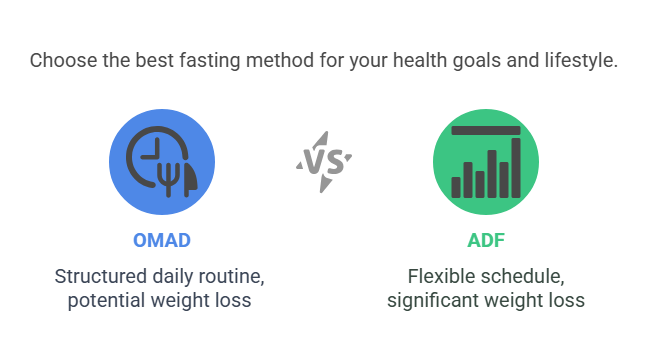
Choosing between OMAD and ADF depends on your personal health goals, lifestyle, and ability to adhere to the fasting regimen.
– **OMAD**: Best for individuals seeking a structured, daily fasting routine with a single meal, aiming for simplicity and potential weight loss. However, it may lead to nutrient deficiencies and is less supported by extensive research.
– **ADF**: Ideal for those interested in a more flexible fasting schedule, alternating between fasting and normal eating days, with a focus on significant weight loss and metabolic health. ADF has been associated with significant weight loss and improved metabolic health, with more research supporting its benefits.
OMAD vs Alternate Day Fasting: The Final Verdict
| Category | OMAD | Alternate Day Fasting (ADF) |
|—————————-|———————————————————————-|———————————————————————————————–|
| Best for Beginners | Individuals seeking a simple, daily fasting routine with a single meal. | Those interested in a flexible fasting schedule with alternating fasting and eating days. |
| Best for Power Users | Not applicable. | Individuals aiming for significant weight loss and improved metabolic health. |
| Best Value | Not applicable. | Offers flexibility and sustainability, potentially leading to long-term health benefits. |
Findings and Recap
In summary, both OMAD and ADF are intermittent fasting methods that can lead to weight loss and health improvements. OMAD offers simplicity but may lead to nutrient deficiencies and is less supported by extensive research. ADF provides more flexibility and has been associated with significant weight loss and improved metabolic health, with more research supporting its benefits. Consider your personal health goals, lifestyle, and ability to adhere to the fasting regimen when choosing between the two.
Start Your Fasting Journey TodayReady to take the next step? Explore our comprehensive guide to intermittent fasting and find the method that suits you best.
Related reading: Understanding Intermittent Fasting: A Beginner’s Guide
AI Image Prompt: A split-screen image showing a person choosing between two meal plans: one with a single large meal and another with multiple smaller meals, set in a modern kitchen.
“`html
Frequently Asked Questions
What is the main difference between OMAD and Alternate Day Fasting?
The primary distinction lies in their fasting and eating patterns. OMAD (One Meal a Day) involves fasting for 23 hours and consuming all daily calories in a single meal within a one-hour window. In contrast, Alternate Day Fasting (ADF) alternates between days of normal eating and days of fasting or significantly reduced calorie intake, typically consuming about 25% of usual calories on fasting days. ([timelesshealth.tv](https://timelesshealth.tv/adf-vs-omad-for-weight-loss-which-fasting-method-works-best?utm_source=openai))
Which method is more effective for weight loss?
Both OMAD and ADF can lead to weight loss by creating a calorie deficit. However, ADF’s longer fasting periods may promote deeper levels of autophagy, supporting cellular repair and anti-aging processes. ([timelesshealth.tv](https://timelesshealth.tv/adf-vs-omad-for-weight-loss-which-fasting-method-works-best?utm_source=openai))
Are there any health risks associated with OMAD and ADF?
Both fasting methods can pose health risks if not practiced properly. OMAD may lead to nutrient deficiencies due to limited meal frequency, while ADF can cause extreme hunger and fatigue on fasting days. It’s essential to consult with a healthcare professional before starting either regimen. ([fitnessvolt.com](https://fitnessvolt.com/adf-vs-omad/?utm_source=openai))
OMAD may be more challenging in social settings due to its strict one-hour eating window, potentially interfering with social meals. ADF offers more flexibility, allowing for normal eating on non-fasting days, which can be more accommodating for social events. ([vimchi.info](https://www.vimchi.info/which-is-better-omad-or-adf/?utm_source=openai))
Can I combine OMAD and ADF for better results?
Combining OMAD and ADF is not recommended, as it may lead to excessive calorie restriction and potential health issues. It’s crucial to choose a fasting method that aligns with your lifestyle and health goals. ([physiqz.com](https://physiqz.com/weight-loss-diets/alternate-day-fasting-vs-omad/?utm_source=openai))
How do OMAD and ADF affect metabolic health?
Both OMAD and ADF can improve insulin sensitivity and support metabolic health. ADF’s longer fasting periods may offer additional benefits, such as enhanced autophagy and reduced inflammation. ([drjockers.com](https://drjockers.com/alternate-day-fasting/?utm_source=openai))
Which method is more sustainable in the long term?
Sustainability varies based on individual preferences and lifestyles. OMAD’s daily routine may be easier for some to maintain, while ADF’s alternating fasting and eating days can offer more flexibility. It’s important to choose a method that you can consistently adhere to. ([fitnessvolt.com](https://fitnessvolt.com/adf-vs-omad/?utm_source=openai))
“`
